The dollar store is a great place to get many practical, quirky and fun things. Household goods, decorations, gifts, you name it, you can probably find it at a dollar store!
Because there is so much to find at dollar stores, it only makes sense that you can find some pretty great stocking stuffers too! Best of all, most things cost only $1.00!
Hand Sanitizer
Travel Size Tissue
Chewing Gum
Mini Notebook
Holiday Pencils
Holiday Erasers
Travel Size Lotion
Coloring Books
Candy Bars
Lip balm
Socks
Hair accessories
Nail Polish
Nail Files
Miniature Toy Cars
Playing Cards
Mini Washi Tape Rolls
Crayons
Chalk
Bubbles
Stickers
Key Chains
Snack Size Chips, Crackers, Cookies
Assorted Kid’s Craft Supplies
Night Lights
What are some other dollar store stocking stuffer ideas? Share them in the comments!
Sometimes, you CAN take money out of your RRSP without penalty. But you have to pay your RRSP back – or pay the tax.
This post is a sponsored post written by Sun Life Financial. See my disclosure policy here.
Are you looking at a major expense you didn’t see coming?
Short of available cash? Perhaps you’re thinking about tapping your registered
retirement savings plan (RRSP). It’s your money, after all, so why not?
Here are three good reasons why not.
1. You’ll owe tax
The first is the tax bill. Since you used
pre-tax income when you put money in your RRSP, you’ll have to pay tax when you
take it out. And while there’s no tax on investment growth inside your RRSP,
you’re taxed when it comes out. RRSPs make sense because you’ll typically cash
them in after you retire. That’s when your income and your tax bracket will
likely be lower. You’ll still pay tax, but you’ll pay less. If you take the
money now, while you’re working, you’ll face more in taxes.
2. You’ll miss out on investment growth
The second reason is lost investment
growth. Every dollar you take from your RRSP is a dollar less to build up
through compounding. So that little nibble from your plan today could mean a
big bite missing from your savings come retirement.
3. You’ll use up contribution room
And the third reason: When you take money
from your RRSP, putting it back generally uses up your contribution room.
What’s contribution room? Each year you can put as much as 18% of your
earned income from the previous year into
your RRSP, up to an annual
maximum. The difference between your limit and what you actually put in
your RRSP is the unused contribution room. You can carry that forward to use
another year. Unused contribution room plus your annual maximum becomes your total
contribution room. But whatever you put in your RRSP – replacing a temporary
withdrawal or making a brand-new contribution – can use up contribution room. Let’s
say you take $5,000 out of your RRSP this year and plan to pay your RRSP back
next year. That repayment will reduce your contribution room by $5,000.
There are two ways to avoid paying tax on RRSP withdrawals,
without using up contribution room:
Use your RRSP to help buy your first home, or
Use it to go back to school.
What’s the RRSP Home Buyers’ Plan (HBP)?
Are you a first-time homebuyer living in Canada? If so, you
can borrow up to $35,000 from your RRSP to put towards a down payment. If you
and your spouse are buying together, that’s $70,000 you could use for your
home.
The HBP lets you take out the money tax-free. But there’s a
catch: You have to pay it back in equal installments over 15 years. Any year
you don’t pay the full installment, you have to pay income tax on the
outstanding balance. You’ll also lose the chance for that money to grow within
your RRSP.
Thinking of using the HBP? When you’re crunching the
numbers, be sure to include the RRSP repayments along with your mortgage
payments.
What’s the Lifelong Learning Plan (LLP)?
This is another way to take tax-free money from your RRSP:
Take out up to $10,000 a year, for a total of $20,000.
You can spread those withdrawals over a maximum of four years.
Use that money for full-time education or training for yourself, your spouse or partner.
As with the HBP, you need to repay your RRSP or pay income tax on your withdrawal.
With the LLP, you have 10 years to repay your RRSP in equal installments.
What about the tax-free savings account (TFSA)?
You might need money for anything at all – not only buying a
home or going to school. An option is your TFSA. You don’t pay tax on TFSA
withdrawals for any purpose. You’ll still lose potential investment growth
while your money is out of the account. But your contribution limit will grow
back. Whatever you take out gets added to what you can put in the following
year. You can pay your TFSA back according to your own schedule.
I’ve got something fun planned for you all. I’d love for you to join me in the 10 Ways in 10 Days to Earn Money for the Holidays email series!
This time of year should be a time of celebration and happiness, not one that is dreaded! Trying to figure out how to come up with extra ways to earn money for this season can be difficult. Luckily, we can do it together!
Instead of blowing your budget or going into debt, 10 Ways in 10 Days will help you find new ways to stash away cash for your upcoming expenses.
You will receive 1 email per day for 10 days with a new idea each day, starting the day after you sign up.
If you know anyone else who could use help saving money for the holidays then share this page with them so they can join the challenge with you!
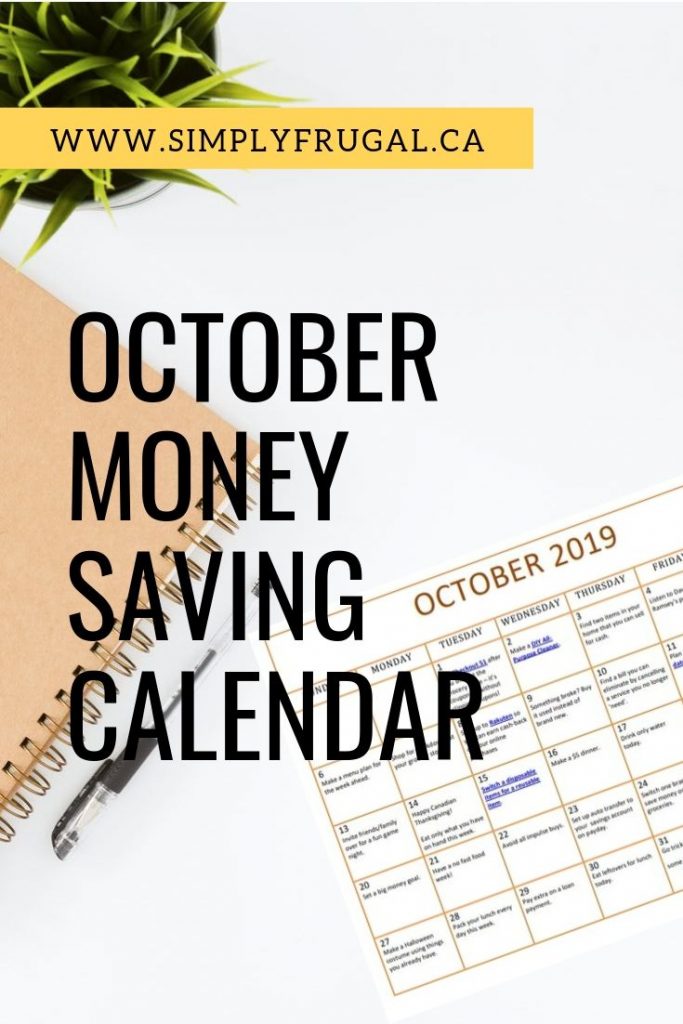
Happy October! Get ready for the quickest blog post ever that will save you a TON of money!
It's a new month and I'm trying something new for you guys. I thought it would be fun to create a calendar each month with a super easy money saving tip each day of the month.
So this month, you get the NEW Money Saving Calendar for October 2019!
Did you know that with just a little bit of prep work and an open mind you may have the possibility of cutting your grocery bill in half?
It's totally possible to eat better quality, healthy food while spending less on groceries. Here are some ways for you to cut your grocery bill without sacrificing taste or your health.
Plan Your Meals Ahead Of Time
I have many articles about meal planning, but this is because I can't stress enough how important meal planning is. Especially if you want to cut down your grocery bill.
There are two ways to go about meal planning. You can plan meals based on what you already have at home or plan based on what is on sale in the flyers at your local stores. The first option would be your cheapest option since you're using ingredients you have already purchased. It's still quite possible that you will have to fill in missing ingredients with a trip to the store.
If you go with the second option, you can then plan and base your meals on the sale items. Most of the sale items will be in season so your meals will be too. By planning your meals to match what’s on sale, you’ll be surprised at how much that will cut from your grocery budget.
Take Advantage Of Coupons
The great thing about coupons and couponing is that you'll never have to shop and pay full price for your groceries, it really becomes a fun game when you’re paying less than full price for your items. So, take advantage of all the coupons you can use to get discounts on grocery items.
You can start collecting coupons from your local newspaper or even from mobile phone apps. There are also websites like Simply Frugal that lists all the most recent Canadian coupons.
Purchase Generic Items
Name brand items can be really eye-catching but they can also have the ability to empty your pockets as well. Often the only difference between a grocery's brand-name product and a store-brand product is the packaging.
If you take a closer look at the list of ingredients, in most cases, you'll actually see that they are nearly identical. It's just the price that's different. So, before you take that name brand item off the shelf, do your research and you'll definitely be rewarded with the best deal.
Tip: Ingredients are listed in order of the amount in the item, so if sugar is the first ingredient in your cereal, you know there’s more sugar in it than anything else in the box. So, when checking ingredients between generic and brand name, be sure they are listed in the same order to ensure you’re getting the same “taste”. This is always a great way to determine which version is the more healthy version, if that is your goal with ingredients.
Buy In-Season Fruits And Veggies
Sometimes you just want to satisfy a craving with out of season fruits and veggies but to really make a dent in your grocery bill, you’ll want to purchase in season produce.
Out of season fruits and veggies will definitely be more expensive because they cost more and take more effort when they are not in season.
Buy frozen produce
Often times, buying frozen fruits and vegetables is more cost effective than buying fresh produce. Frozen vegetables are perfect for quick dinner sides and soups. Frozen fruit is perfect for smoothies, or fruit crumbles or even sprinkled over yogurt. I also like to freeze fresh cherries that we pick from a local orchard for $1.50 a pound each year.
Plant A Garden
Growing your own food is the best way to go when you really want to lower your expenses and save money on your grocery bill. A great example is having your own herb garden.
If you buy a bunch of herbs they can be expensive and you may only need them for a meal or two (this is again where meal planning can be helpful). But if you have some potted herbs in your garden or kitchen, you'll save a lot of money and have those herbs at your fingertips anytime you need them. Plus fresher always tastes better.
Cutting your grocery bill without sacrificing is definitely doable. It will just require you to make a few changes and find what works for you and your family. Taking control of how your money is spent and saved is a great feeling when you’re trying to stay within a budget.
What are your best tips for cutting your grocery bill? Please tell us in the comments below.
One of the ways I began to save extra money was by ditching some of the disposable products we used in our home and replacing them with reusable household items.
In the beginning, this did cost us a few more dollars but quickly turned into big savings each month we weren’t purchasing the disposable versions!
Now, I know the appeal of disposable items. They can be so gosh darn convenient! But by simply switching out one disposable product for a reusable product, not only will it have a positive impact on our planet, it will also have a positive impact on your wallet! Before you know it, you'll be trying to replace every household product with a reusable one!
Below, I've listed the best reusable household items that we’ve been loving in our own home lately!
Wool Dryer Balls
For years now I have been using wool dryer balls in place of dryer sheets and fabric softener. In fact it's been a while since I bought my wool dryer balls so they're finally starting to fall apart!
If I ever feel like having a bit of a scent to the laundry, I'll add a couple drops of essential oil to a couple of the balls.
When purchasing wool dryer balls, make sure they are 100% wool. This will ensure fluffiness, reduce static and reduce drying time.
Reusable Water bottles
Before we leave the house, I make sure all of our reusable water bottles are filled up so we can avoid buying a bottle of water when we're out and about.
While any reusable water bottle will work, our favorites are the ones that are insulated. They keep water cold for much longer! My husband and I are using bottles like these while I like the Thermos ones for our daughters.
Kitchen towels
Ditch the paper towels once and for all! I have one roll of paper towel on hand and that is to check the oil in our vehicles and for wiping up cooking grease. Other than that I use kitchen towels, cloths, and big bath towels for cleaning up spills, and wiping dirty fingers and faces. Basically reusable towels are used for everything paper towels are typically used for.
It's so easy to make the switch to reusable straws! We've got two different kinds that we use at home. Stainless steel and super fun silicone ones. I don't have a preference for myself, but my daughters like the silicone ones the best. Probably because they're soft (safer for kids!) and fun colored.
Be sure to get a small straw brush to keep your straws clean!
Reusable K-Cup
We were gifted a Keurig coffee maker years ago and it's still one of our favorite appliances and gets daily use. The one thing I don't like about it is the k-cup waste. However, we recently switched to a reusable K-Cup and love it! It's so easy to use and the coffee tastes just as good. Plus now we can get a big bag of ground coffee beans (cost effective) or use the locally roasted beans that we love.
Reusable shopping bags
Now that most grocery stores are charging for plastic grocery bags, I want to avoid that unnecessary expense as much as I can! I have reusable grocery bags stashed in the car and both of my bags in hopes that I won't have to use a plastic bag.
The reusable shopping bags that I have are similar to these ones and fold up really small and are so easy to stash in my purse. I love that they are washing machine friendly so I can toss them in the wash once in while!
Silicone baking mats
With silicone baking mats, there's no need to spray your cooking sheets or use parchment paper. That means you could possibly eliminate two grocery items from your list saving you a bundle in the long term.
Silicone baking mats are really easy to clean and hardly take up any space in your cupboards.
Mason jars
Open up the cupboards or even your fridge and you're bound to find some sort of glass jar! Wash and reuse the glass jars that you find for so many things. I use mine for storing dried beans/lentils/rice, freezing broth, holding makeup brushes and so much more.
Mason jars are fairly inexpensive to buy if you want matching jars. Scour the garage sales too!
Reusable Sandwich Bags
This is a new purchase for us and I'm loving it! I used to wash our plastic sandwich a few times before tossing them, but I'm liking this alternative way better.
These reusable storage bags are freezer friendly, leak-proof, come in various sizes and clean easily.
Travel Mugs
These are a must-have in our family! Every morning, instead of hitting the drive thru, my husband makes a travel mug full of coffee for his morning at work. Saves a ton of coffee money over the long run! I'll bring mine along when I've got a bunch of errands to do. But even if you do go to a coffee shop or something, many places offer a small discount if you bring your own mug. (Starbucks, for example.)
Using these reusable household items is such a great way to begin moving towards a more eco-conscious way of living plus you’ll be saving a lot of money over the long term!
I'd love to know what reusable household items you would add to the list!