Is your garage stacked to the ceiling with stuff? If so, it might be time to give it a good cleaning. Cleaning out your garage can not only give you more space in your home, but can also net you some cash in your pocket! Want to know more? Take a look below at these 5 ways to make money by cleaning out your garage, I’m sure you’ll find something you can sell!
5 Ways to Make Money By Cleaning Out Your Garage:
1. Sell your old/unused tools.
Are you a tool hoarder? Tools have excellent resale value. Sell your usable power tools Kijiji, Craigslist, Facebook Buy & Sell groups or place an ad in the local paper. Older tools might be valuable to collectors, so do your research on them and see if they might be worth anything. You typically need just one of each tool, so part with any extras to make some quick cash.
2. Scrap that metal.
Is your garage full of metal pieces? If so, you can scrap them for cash. Old appliances, fencing, old copper, brass, or even aluminum are all worth cash at a local metal recycling center. You don’t even need to clean the pieces, just haul them to the center, have them weighed, and collect your cash.
3. Sell your old bikes.
Bikes both old and new can find a new home on Kijiji, Craigslist, ebay, or your local paper/garage sale site. Collectors are always looking for bike parts and will be willing to take the old bikes off your hands, while college students are always looking for used bikes they can snag for a song. If you have any bikes either old or new, broken or functional, sell them for cash.
4. Hold an odds and ends garage sale.
Get rid of the random clutter with a garage or yard sale. Advertise your sale for free in Facebook Buy & Sell groups as well as sites like Kijiji or Craigslist. Price your items to sell, create a neat and organized display, and you are sure to not only pull in some cash but create some extra space in your garage as well. Just haul out those items, give them a good dusting, and stick a tag on them. It’s that easy!
5. Donate for a tax write off.
Remember, you can get a tax deduction for any donations you make to not for profit agencies. If you have functional items such as toys, hoses, lawn tools, appliances, bikes, wagons, etc. then why not donate them? You will get a receipt for your donation and you will be able to write the amount off on next year’s taxes. That’s like cash in the pocket!
Don’t deal with that cluttered garage any longer. Instead, give these tips for finding money in your own garage a try and you will not only make space, but make some money as well.
Have you found any treasures hidden in your garage lately? Let me know in the comments.
Odds are, when you started your garden you were not thinking about how you could earn money from it. Over time you may have seen a bit of potential and started to think about how you could make money from your garden. Even a small thriving garden can earn a bit of extra money. If you are skilled or have plenty of space you can earn even more.
Today, I'd love to outline some ways that you can Earn Money from your Garden.
Sell extra produce
Often, the first issue that makes you think about how you could earn money from your garden is an overabundance of produce. You may be wondering just how you could ever use up that many tomatoes. Selling that extra produce is a great way to earn some cash and help save someone else some money. First, offering the produce for sale to friends and family will definitely help you reduce your overabundance. If you still have produce leftover, post a sign in front of your yard advertising produce for sale. You may have many neighbors stopping by!
Selling canned goods
Check your Province or city's food laws to see if you can earn money from your garden by canning extra produce and selling the jars. Selling homemade jams, jellies, and other canned goods just might be the answer for you. Due to law, your sales are often limited to a few thousand a year, but that's perfect for using up the extra food from your garden. Homemade canned jams and jellies make great gifts around the holidays and can end up selling very well.
Sell plants
Are you a whiz at getting seeds to sprout into strong thriving seedlings? Do you have plants in your garden or pots that need to be thinned out? Selling plants to other gardeners in your neighborhood is a great way to earn extra money from your garden. If you do not have plants to sell how about seeds? Cuttings from that prize plant your neighbors all love?
Teaching others gardening skills
Have you been gardening for years and have a beautiful thriving garden that neighbors admire? Why not offer to teach gardening classes in your home garden or even at the local library for a small fee? Depending on local interest, you can earn a good bit of money running classes on the topics of caring for plants, propagating cuttings, and keeping plants alive for the not so green thumbs. Often a bit of education is all that stands in the way of a thriving garden. Many parents are looking for summer activities for their children and learning to garden could be a great use of time and energy.
The important part of making money with your garden is to not allow the focus on earning to take the joy out of your garden. If you lose the joy that made your garden thrive in the first place, your garden will suffer. So start out small, have fun, and make the most of the opportunities that come your way.
Have you tried making some extra money from your garden? How did you do it?
Have you indulged in some poor spending habits lately? If so, then it's time to get your budget back on track. I find once I'm on the spending train, it's hard to get off! However, I do manage to disembark eventually with a few tips I've used over the years. Take a look below at these 7 surefire ways to get your budget back on track and find your way to financial freedom.
7 Surefire Ways to Get Your Budget Back on Track
1. Go on a spending freeze.
First and foremost, if you're stuck in the vicious spend cycle, you have to just stop. Begin by vowing not to spend any money for 10-14 days. In this time, use what you have on hand and refuse to buy anything new. See how much money this spending freeze can save you. You might be surprised! You might also be surprised to find that you can be content without spending money on "stuff" because you've discovered new ways to occupy yourself.
Following your freeze, track your spending for 10-14 days. If you spend so much as a dime, write it down. At the end of your tracking period, see where your money is going. This visual data will help you see where serious cuts need to be made.
3. Start cutting!
Use the data from your spending tracking to see where cuts need to be made. Get serious about seeing these cuts through. Find ways around these purchases and then stick to it. Some examples may be eliminating eating out, turning cable off, buying less clothing for your kids or giving up monthly magazine purchases.
4. Bring friends on board.
If you need to get your budget back on track, be honest with your friends. Let them know about your goals so they aren’t trying to convince you to spend money when you shouldn’t. This way, you will also have a support system in place.
5. Celebrate small victories.
When you complete your spending freeze or tracking, or make bug cuts, celebrate! Plan a family fun day or go on a cheap date. Or, if you can, put aside $5 into a vacation fund each time you save $50. Knowing there is a reward each time you accomplish something, can be enough to keep you pressing onward.
6. Track your progress.
Each time you make a successful cut or save a dollar or two through your hard work, write it down. Track your savings so you can see how much your hard work is paying off. At the end of the week, check out your total savings and give yourself a well deserved pat on the back.
7. Don’t quit.
Even when you see the savings add up and the budget gets back on track, don’t stop! It will be important that you keep these tips in mind and perform regular check ups on your budget to stay on track.
See how simple it can be to get your budget back on track? With these tips and a bit of hard work you'll soon be seeing a difference in your budget.
Do you have any tips that help you get your spending under control? Please share in the comments!
Have you heard of the Canadian Scanner Price Accuracy Code? It could be very valuable to you!
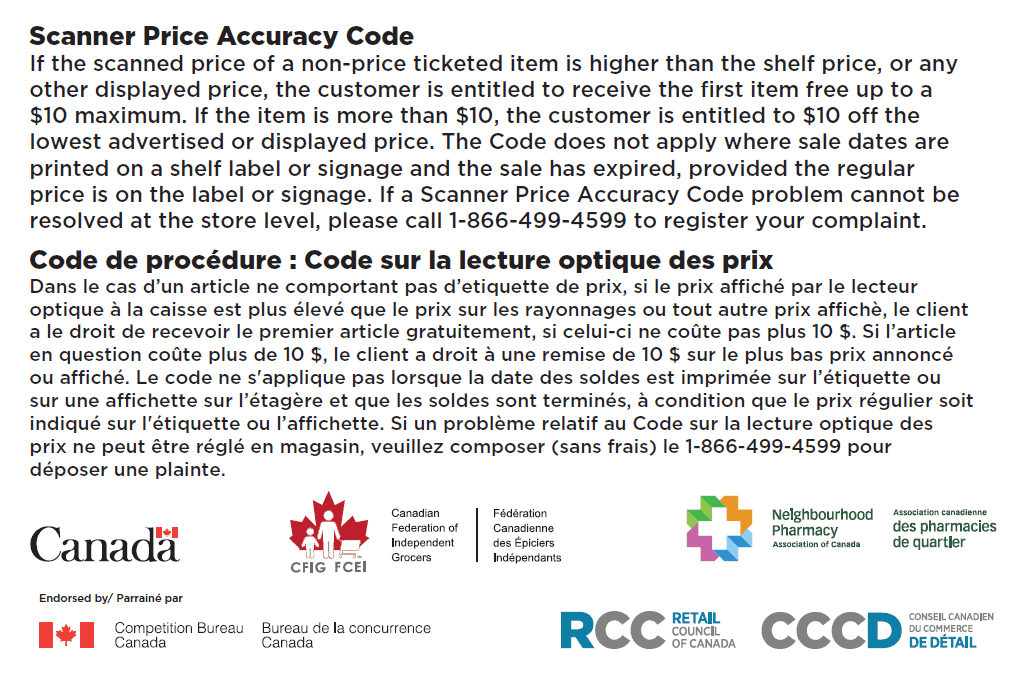
Most Canadian retailers take part in this practice. In Quebec it's the law and in other provinces, it's voluntary. Basically, if you purchase an item believing it to be a certain price but the item actually scans at a higher price then advertised, you receive the item free up to a $10 value! If the item is priced more than $10, then the retailer will give you a discount of $10 off the corrected price.
The code applies to all UPC, bar coded, and/or Price Look Up (PLU) merchandise sold in stores, with the exception of goods not easily accessible to the public (example: prescription drugs and behind the counter cosmetics), and individually price-ticketed items.
To be eligible for the Item Free Scanner Policy, the item must match the product description on the corresponding shelf tag.
Does that make sense?
Quite often the cashier won't give you the product free without you mentioning the Scanner Price Accuracy Code. So if you notice a wrong price, speak up!
At participating retailers you should see a sign on the entrance doors and at the till that reads:
Now that spring is here, your local dollar store will no doubt be well stocked with flip flops in every color and style. Snagging flip flops at your local dollar store isn’t just budget savvy, these flip flops can come in handy all throughout the summer for all sorts of reasons. Want to know more? Look at 5 reasons to stock up on dollar store flip flops so you can make the most of these little gems! You will be amazed at how valuable they can be.
5 Reasons to Stock Up on Dollar Store Flip Flops
1. Keep emergency pairs in the car.
Have you ever had a pair of flip flops break on you? When that happens you can find yourself in a pickle. Buy an extra pair of flip flops for everyone in your family and keep the pairs in the car. That way should you encounter any breaks, you have a back up. For just a buck, it is well worth buying extras and tossing them into the trunk for emergencies.
2. They make cute garden markers.
Buy a few pairs of children’s flip flops and use them as whimsical garden markers. Add some hot glue to the back of them and press them to a wooden stake. You can then write the name of the plant directly on the flip flop with a magic marker. How cute is that?
3. They make for fun pool time.
The fun thing about flip flops is they FLOAT! You can use them for all sorts of pool games. On the underside of your flip flops you can draw words or shapes and use them to play matching games. You can also craft mini boats with them, allowing kids to decorate the flip flop as they wish before setting it sail. These ideas make for some frugal summer fun.
4. Flip flops are perfect for protecting floors and walls.
The rubber that flip flops are made from is durable. Grab a few pairs of dollar store flip flops and cut the foam into squares. You can then use the foam pieces as door stoppers to protect your walls or even place them under table and chair legs to protect the floors. Add some of these foam chunks to planters and flowers pots and they can help act as fillers and even help absorb water.
5. They make inexpensive gifts.
Don’t get caught without a gift this summer. A pair of flip flops with a ribbon tied on makes the perfect gift for a hostess or summer birthday. They are also great to give as party gifts if you are hosting any backyard parties or cookouts. Guests will love getting a pair of flip flops to relax and unwind in.
Who knew flip flops could be so valuable? For just a dollar or so each, they are well worth stocking up on during the warm weather season. Consider these 5 reasons to stock up on dollar store flip flops and put this inexpensive find to work for you.
Are your monthly water bills sky high? Do you feel like your family isn’t vigilant when it comes to preserving this resource? It’s so easy for people, myself included, to get into wasteful habits. However it can also be easy to pull out of these habits. If your family is using more water than it needs each month, it’s time for an intervention. Look below at 7 ways to encourage your family to use less water, so you can be sure to not only save a few bucks but help save the planet’s resources as well. Here are 7 tips to get you started.
1. Keep a timer in the bathroom.
A timer in the bathroom can help cut down on lengthy showers which no doubt send tons of money and water down the drain. A simple minute timer near the shower is a great way to set the allotted time and hear a reminder when it’s time to get out.
2. Encourage turning off the tap while brushing teeth.
One of the easiest ways to waste water is to let it run while you brush your teeth. A family can send gallons down the drain this way. Make it a family rule that the tap should be turned off when teeth are being brushed. This way, water isn’t needlessly going down the drain.
3. Model water conservation when you cook and clean.
When you cook and clean, model water conservation to your kids. Fill the sink with a bit of water to wash produce instead of letting the water run freely. Don’t fill up pots with any more water than you need. Then be sure to save this water so you could water house plants or your flower pots outside. When cleaning, don’t let water needlessly run unless it’s time to rinse the sink or your cleaning supplies. When you model this behavior, kids are more likely to try it.
4. Take short showers instead of baths.
Try to convince family members to take showers instead of baths. You will waste less water this way and even your water heater will get a break. If kids really love baths, see if you can convince them to take more showers and stick to one bath per week.
5. Get sufficient wear out of clothing before tossing it in the wash.
Don’t let kids toss clothing in the wash after it has been worn only once. (Unless it’s truly dirty!) Teach them to evaluate clothing and make sure it is in need of a wash. Jeans can be worn several times before they need to be cleaned, as can most sweaters. Don’t be so quick to toss clothing in the wash and instead get a few uses out of it.
6. Don’t run dishwashers/washing machines unless they are full.
Running a half full dishwasher or washing machine is quite wasteful. Instead, be sure no one runs it unless it is 100% full. Show family members what that looks like so they know how to make the best use of the space both appliances offer.
7. Avoid filling sinks, tubs, and cups all the way full.
When taking a bath, doing dishes, or even getting yourself a drink of water, avoid filling items all the way full. See if you can use less water and still get the job done. When drinking water, of course you can always pour more once the original amount is gone. This just prevents you from pouring more than you can drink in one sitting.
Are you ready to start using less water, start saving money, and start being kinder to our planet? Then try these 7 ways to inspire your family to use less water and see how easy it can be!
I’d love to hear what works for your family when it comes to saving water! Let us know in the comments below!