We all know buying in bulk is a great way to save money for our families. When you buy larger quantities you pay less for each ounce, serving, or piece. Sadly sometimes our best intentions to save money by purchasing in bulk, costs us more money than we intended. The good news is, all of those great intentions can pay off and you can buy in bulk to save money with a little planning and know-how.
Use the tips below to help you learn how to buy in bulk to save money.
Decide if bulk is worth it for your family.
Smaller families do not need to buy everything in bulk because when food goes bad you are not truly saving anything. Some things like toilet paper and cleaning supplies are great to buy in bulk for everyone. They will never go bad and you can get your money's worth from a purchase like that. However, in most cases, a small family may find it challenging to go through large quantities of perishable items before they go bad.
Compare bulk price to the regular price.
Sometimes buying in bulk is not as good of a deal as may sound. Take the time to divide the price by ounces, servings, or pieces so that you can see how much you are really paying. When sales hit it can often be better to buy the smaller packages than to purchase the bulk one, not on sale.
Check expiration dates and rotate your stock.
It is really easy for things to be forgotten in the back of the pantry or freezer for a long period of time. Only to be discovered when it is too late. Grab a sharpie and put dates in large print on everything. Move new items to the back when putting your groceries away to avoid using the newest items before the old.
Store items well to make them last longer.
Airtight containers can keep your bulk supplies fresh longer. A vacuum sealer can keep that fresh meat you found a great deal on from being freezer burnt before you can use it, and storing produce like carrots in water will keep them fresh longer giving you time to use them.
Plan your menu to use up fresh items before they go bad.
Nothing can ruin a great deal like not using what you bought before it begins to rot. When purchasing produce in bulk you really want to be sure you have a plan to use it. When we find a really good deal we plan to use it in every meal and snack we can to be sure it gets used.
Compare prices and selections at your local wholesale clubs BEFORE buying a membership.
Often places like Costco will let you in to check out the selection before you buy a membership. Compare the prices of the top ten things your family will be buying in bulk and go with the club membership if that will give you the best deal on these items.
Look for bulk in unexpected places.
Often supermarkets will have bulk basics like flour in 25-pound sacks available. Your local farmer's market is a great place to find a deal on bulk produce from local farmers looking to clear out stock by the end of the day. You do not have to purchase a wholesale club membership to buy in bulk if you take the time to shop around helping you save a bit more money when buying in bulk.
Do you find buying in bulk is worth it for your family? What things do you most often buy in bulk? From where?
When it comes to tricks to help save time, money and stress, freezer cooking is at the top of my list. Freezer cooking can completely change the dinner time hour in your home. With a little bit of planning ahead, you can have have delicious, healthy meals for your family from the freezer instead of taking a spin through the drive through… again.
Do you find yourself constantly overwhelmed at dinner time? Help tame the dinner time madness with these tips for great freezer dinners!
Make a menu.
You hear it all the time, but that’s because it works. A menu means you can shop once and do prep work as you put the food away. You’ll probably find that you don’t have to look inside the fridge multiple times a day only to decide that thinking about what will be for dinner is just too much, again.
While I like to plan a week’s worth of meals, you may want to just plan enough meals to get you until your next shopping day. I recommend planning to double 1 – 2 meals so that you can put the extra into the freezer. Perfect for days when you don’t have time to shop or prepare a meal from scratch because of activities.
Prep before putting food away.
The fastest way to create many meals for the freezer at once, is to go shopping in the morning and spend the afternoon completing the prep work. This is great for working parents or families with a lot of activities during the week.
Chop all of the ingredients for one meal and load right into freezer bags for a complete recipe.
When you are cooking and baking, double your recipes to cook once but eat twice! This is a great way to reduce your workload because you can cook once and clean once.
This works really well for casseroles, tomato based sauces, cookies and muffins, and soups. I love to make a big batch of spaghetti sauce and freeze the extras. The same goes for taco meat.
Cooking double is the least stressful way to build a large stash for your freezer with very little extra effort on your part. No all day cooking or menu planning but you will be building a stash of meals for busy nights.
Protect from freezer burn.
While freezer cooking is amazing for saving you time and money, you will find that things may get freezer burnt causing unnecessary waste.
To prevent freezer burn, remove air from packaging and use multiple layers around your food to keep it fresh longer. Never let air get into your packaging. Label your meals well so you do not need to open anything to find the meal you want.
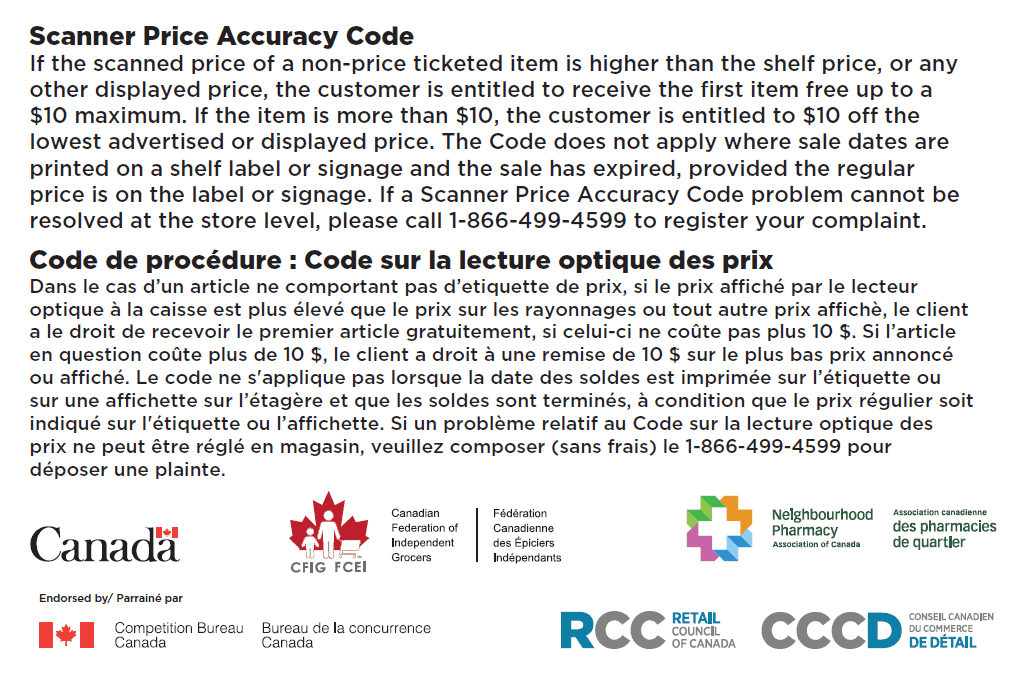
Have you heard of the Canadian Scanner Price Accuracy Code? It could be very valuable to you!
Most Canadian retailers take part in this practice. In Quebec it's the law and in other provinces, it's voluntary. Basically, if you purchase an item believing it to be a certain price but the item actually scans at a higher price then advertised, you receive the item free up to a $10 value! If the item is priced more than $10, then the retailer will give you a discount of $10 off the corrected price.
The code applies to all UPC, bar coded, and/or Price Look Up (PLU) merchandise sold in stores, with the exception of goods not easily accessible to the public (example: prescription drugs and behind the counter cosmetics), and individually price-ticketed items.
To be eligible for the Item Free Scanner Policy, the item must match the product description on the corresponding shelf tag.
Does that make sense?
Quite often the cashier won't give you the product free without you mentioning the Scanner Price Accuracy Code. So if you notice a wrong price, speak up!
At participating retailers you should see a sign on the entrance doors and at the till that reads:
Simple Ingredients to Keep on Hand for Slow Cooker Meals
Do you love using your slow cooker? It’s the perfect appliance for getting a hot meal on the table with little effort and little expense. But do you know which items to keep on hand if you own a slow cooker? There are in fact, a few ingredients that can help you get a meal on the table quickly, even if you haven’t planned ahead. Take a look at these 7 items to keep on hand for great slow cooker meals, so you can put a meal together even at the last minute.
1. Canned cream soups.
You can dress up so many cuts of meat with a can or two of creamed soup. Cream of mushroom, celery, and chicken soups all dress up chicken and pork nicely. You can pour a can over your cut along with some water, seasonings, and vegetables if you have them and have a tasty dish in no time.
2. Barbecue sauce.
Make quick slow cooker ribs or slow cooker chicken when you add in the cut of meat along with some barbecue sauce. You can also add chopped onions if you wish to add some extra flavor, but even the sauce alone will dress up the meat nicely.
3. Ranch mix.
Dried ranch mix can spice up your chicken and even a beef roast nicely. Just sprinkle the mix in and add some butter and you will have flavorful chicken or roast that your family will love. If you have fresh veggies you can add them, but the ranch mix does well on its own.
4. Onion soup mix.
No fresh onions on hand? No problem! Dried onion soup mix can really dress up a cut of meat. Just add it along with some water and it will flavor the meat nicely. Of course you can add fresh veggies if you have them, but if not the onion soup mix is quite flavorful alone.
5. Rice and noodles.
You can bulk up any meal with some rice or noodles. Add rice or noodles along with the cream soup of your choice for a fast meal. You can also use them to make quick casseroles, soups, or stews. Rice and noodles are both cheap when bought in bulk, so stock up.
6. Certain cuts of meat.
Try to keep certain cuts of meat in your freezer so when you need to toss a quick meal in you can. Simple ribs, chicken breasts, or even an inexpensive roast all do well in a slow cooker. If you see these items on sale, stock up for future meals. They are so easy to dress up and prepare in a slow cooker.
7. Dried seasonings.
Stock up on dried seasonings. This doesn’t mean just salt and pepper, but seasoning salt, garlic salt, chili seasoning, taco seasoning, beef stew seasoning, Italian seasoning and ranchand onion soup mix as mentioned above. All of these seasonings can be added to your slow cooker along with some water for a fantastic meal.
Make sure you are slow cooker ready when you keep these 7 slow cooker must haves on hand. They are sure to come in handy when you are preparing your next slow cooker meal in a pinch!
I’d love to know what you make most often in your slow cooker?
Grocery shopping mistakes that are keeping your grocery budget high.
Learning how to reduce your grocery bill is one of the fastest ways to start fixing the entire family budget. Since groceries are not a fixed expense like your mortgage or rent, it’s possible to tweak your shopping habits in order to reduce the amount you’re spending on groceries each week/month.
If lowering your grocery budget is your goal, you’ll want to read on to learn how to fix your unintentional grocery shopping mistakes. Are you committing any of these grocery shopping faux pas?
1. Visit the store several times each week.
I’m guilty of this one more times than I’d like to admit! Going to the grocery store more than once a week can be a real grocery budget killer. After all, going to the store for “just a few things” almost always means you’ll be picking up more than “just a few things” because admittedly, grocery stores have enticing sales and products. So by sticking to shopping once a week you can avoid many impulse purchases, especially if you’re prepared with a list and meal plan.
2. Go to the store around meal times or when you’re hungry.
One of the golden rules of grocery shopping on a budget is to never shop when you’re hungry. Trying to stick to a grocery list when you’re hungry is nearly impossible. Soon you’ll find bags of chips or expensive granola bars hopping into your cart because they’re easy to eat as soon as you get to the car. The best course of action is to shop right after you’ve eaten a good size meal.
3. Don’t plan a menu
I’m a firm believer that planning a menu each week is a big key to sticking to your budget. When you have a plan laid out, you will know exactly what you need to buy at the grocery store in order to execute the meals you have chosen. That way, if something jumps into your cart that isn’t needed, it’s easier to put it back in order to stay within budget because you know that your eating needs are met with your meal plan.
4. Never use a list
Going hand in hand with planning a menu, creating a grocery list is crucial to staying within your budget. I keep a running grocery list on our fridge so I can write down pantry items that I need to replace as soon as the item runs out. As I’m planning our menu for the week, I grab the list from the fridge and jot down everything I need to buy to complete each meal. Sometimes my list is small because I have many items already on hand in the cupboards thanks to some sales in previous weeks on staples.
5. Don’t bother looking at the store flyers for sales.
Reviewing the grocery store flyers and noting what is on sale will save you tons of money. Especially when you buy the sale items and then plan your menu around them. Over time as you regularly buy items that are on sale and stock up on them as much as you can, you’ll always be eating “cheap” food, and your grocery budget will be very happy.
6. Take the kids with you.
Kids can be pretty good negotiators (at least mine can!), especially if you want to be as fast as you possibly can in the grocery store. Sometimes it’s really tempting to buy them something (anything!) just so they’ll be quiet. Even if it’s something little, it all adds up and may not be a good healthful choice.
7. Don’t take inventory of what you already have on hand.
Buying unneeded items can be wasteful. Especially if they’re fresh items that can spoil. Take a few minutes to review what you already have in your pantry and fridge and you can save hundreds of dollars each year.
8. Don’t pay attention as the cashier is processing your purchase.
Put down the magazine and pay attention to what is being rung through. I was recently charged for two watermelons when I had only bought one. Thankfully, I noticed and it was fixed right away. But imagine if each week there was an error on your bill, that could add up to hundreds of dollars that were literally spent on nothing. So do yourself a favor and pay attention as the cashier is processing your purchase. Also, if you bought items on sale, watch closely, you may get several items for free if they scanned wrong since many stores have a scanning code of practice.
9. Throw the food into the fridge without any rhyme or reason.
By taking the time to carefully put your perishables away and dividing items you bought in bulk into smaller portions will save you money in the long run. Washing and storing produce properly will make it last longer in your refrigerator. Make sure you have designated spots for each item so you can easily find your purchases, or your grocery budget will be wasted on moldy, forgotten items.
10. Throw away leftovers.
Not a fan of eating leftovers? Well, that will have to stop if you want to lower your budget! If you’re throwing away leftovers, you’re almost literally throwing your money in the garbage too. There are plenty of recipes online that can help you reinvent leftovers into something tasty. Maybe it’s not that you don’t like leftovers, maybe you simply forgot they were there. One solution is to put leftovers in clear containers with a dated label so you can visually see what’s there.
Are you guilty of any of these grocery shopping mistakes? I know that I am. It’s constantly a work in progress for me! But knowing where you’re making mistakes is half the battle to getting your budget on track. Knowing the ways in which we’re ruining our grocery budget allows us to focus on one area to fix at a time. Baby steps 🙂
10 grocery shopping mistakes you are making that keep your grocery bill high.
Your grocery budget probably needs a little revamping like mine does, and so I came up with a few tips for creating what I believe, is a functional grocery budget. This method of dividing up your expenses will help you to make sure you aren't overspending, and of course, help you to make the most of your money.
3 Steps to creating a grocery budget:
Track your grocery spending. Track your spending over a couple of months and come up with an average. Or look at your receipts from the last couple of months to figure out an average. You will want to look at what you are spending at the grocery store and restaurants. It will be a big help to have these separated so you can see where you need to cut down your spending most.
Set your grocery budget - Because you now know the average amount you spend at the grocery store and restaurants each month, you can set your goal for your grocery budget. For example, if you've discovered you spend on average $800 a month, you might want to set your goal at $700 by cutting down on restaurants and prepackaged grocery store food. I don't recommend drastically trimming your grocery budget right this instant. Give yourself some slack and don't put pressure on yourself to come up with an impossible-to-stick-with number. You'll get discouraged and may end up giving up.
Make your grocery list with your new grocery budget in mind. Having a plan for your grocery budget is how you are going to succeed. Pick recipes and ingredients that are simple. Plan for leftovers to stretch the budget.
In addition, here are some practical tips to help you stay within your newly created grocery budget:
Don't forget to budget for all meals and snacks, not just dinner.
Many menu plans include only 1 meal a day – the evening meal. This doesn't help you to create a shopping list or functional grocery budget when it doesn't provide for breakfast, lunch or snacks. You need to focus not just on the menu plans that give you low budgets for one meal a day, but also plan for your breakfasts, lunches and snacks.
Make healthy foods a priority.
One thing often seen in a grocery budget is not enough room for healthy foods. If you are sacrificing your health to save a few dollars each month, it isn't worth it. Feeding your family great nutrient-dense meals and snacks isn't an option – it is a necessity. Consider the 40/30/30 rule when shopping for groceries. 40% of your grocery budget is fruits and vegetables. 30% of your grocery budget is lean meats and dairy. 30% of your grocery budget are things like dry beans, rice, spices and other items to fill in gaps in the menu plan.
Use coupons only on items you need.
While I'm a fan of couponuse, when it comes to your grocery budget it is important to not get carried away. The thrill of the coupon hunt can quickly become a reason to spend more money for the sake of the “deal”. Make sure you are couponing for items that truly are needed and the best deal possible. Just because there is a coupon available doesn't mean that they should be used.
Plan meals that can be used multiple ways.
Not only do you want to plan low-cost meals, but you want to plan for things that will provide you with leftovers for lunches or a second evening meal. You may also want to look for meats and protein sources that are versatile. Things like a roast or hamburger can be used in multiple recipes making them easier to buy in bulk packages and stretch further. A roast cooked on Monday can have leftovers used in a quick beef and vegetable soup, stew or even tacos or chili. A whole chicken can be shredded and added to soups, casseroles, salads and sandwiches. Using every bit of the cheaper cuts of meat throughout your weekly menu plan can easily make your grocery budget manageable.
Follow your local sale cycles to stockpile as needed.
Sometimes it's beneficial to buy extra of select items when they are at their lowest prices. This could be vegetables and fruit in the summer months to freeze for later, or could be canned goods in winter months. Watch your local stores' sale cycles and stock up accordingly to provide your family with food at the best prices possible year round.
These tips for creating a functional grocery budget are just the beginning. To really do well you also need to take into consideration your area, sale cycles and your family needs. A functional grocery budget is one that provides your family with great meals while staying within the expense plan you can afford.