May 16 | Freebies

Download a free printable Travel Expense Budget Tracker from The Teacher’s Wife.
Jan 2 | Household Tips, Freebies, Holidays, Organization

Well, Christmas is finished for another year. You may be thinking of taking down all your decorations but dreading the mess that your storage area becomes. Or what about next Christmas when you can’t find the specific decorations you’re looking for?
Look no further, I’ve got you covered with this handy Christmas Decoration Storage Inventory printable! Simply print out a page or two (depending on how many boxes you have) and get to work filling the paper out as you put away decorations. Label the boxes with the corresponding number that you have marked on the papers. For example, on the paper, box #1 includes all the Christmas lights. Be sure to label the actual box with #1 too!
Print your Christmas Decoration Storage Inventory printable here.
Oct 31 | Freebies, Holidays
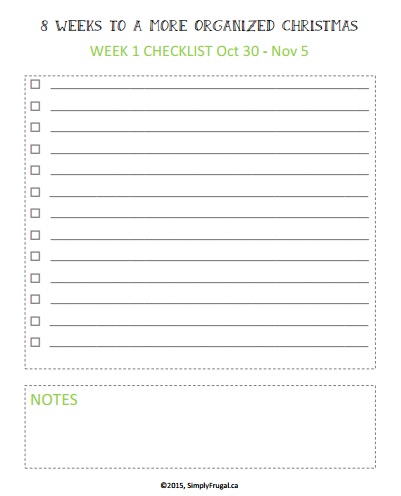
The 8 Weeks to a More Organized Christmas series started yesterday, but I wanted to make a separate post with the downloads I made available to you!
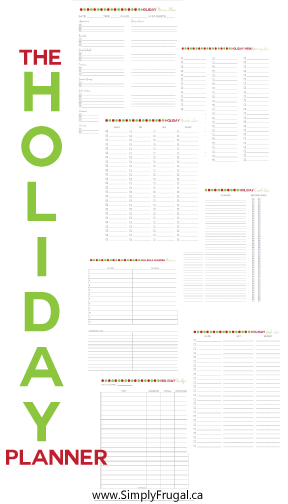
There are three different packages to download. The first being blank checklists that you can personalize with your very own things you’d like to get done. The second is a set of checklists with some suggested things to get done each week leading up to Christmas. The third is a Holiday Planner that is the Simply Frugal store!
Simply Click on each image to access the downloads! I hope they’re useful to you!


The Holiday Planner is available for $4.97 and includes 7 useful printables that will ensure you have an organized holiday season. There’s also a bucket list that will help you get all the sightseeing, craft making, movie watching and whatever else tickles your Christmas senses. 🙂

Jun 30 | Freebies
Looking for a fun outdoor activity that will get the kids excited? You’ve got to print out this Nature Scavenger Hunt then! It will get the kids running all over the place discovering exciting things that can be found in nature.

Click here to get your free Nature Scavenger Hunt printable or click on the image above. It’s also available in the Summer Bucket of FUN.
You could turn this into a fun learning activity by discussing each item on the list. I bet the kids will be fascinated to learn unique details about each object. In case you need some help, I’ve listed a few interesting facts about each item below:
Butterflies:
- Butterflies can’t hear, but they can feel vibrations.
- Butterflies taste with their feet.
- Butterflies breath through openings on their abdomen called ‘spiracles’.
Clouds:
- Every planet with an atmosphere has clouds. That includes the moon.
- Clouds are white because they reflect light from the sun. Gray clouds become so filled with water that they don’t reflect light.
Ladybugs:
- Ladybugs bleed from their knees when threatened.
- A ladybug’s bright colors warn predators to stay away.
- Ladybug larvae resemble tiny alligators, with elongated bodies and bumpy skin.
Caterpillars:
- Caterpillars are nicknamed “eating machines” since all they do is eat, eat and eat
- The life span of a caterpillar is approximately from two to four weeks
- Caterpillars breathe through little holes on the sides of their bodies called spiracles, not through its mouth. The mouth and strong jaws, called mandibles are just for chewing their food.
Flowers:
- Roses are related to apples, raspberries, cherries, peaches, plums, nectarines, pears and almonds.
- Tulip bulbs were more valuable than gold in Holland in the 1600s.
- The largest flower in the world is the titan arums, which produce flowers 10 feet high and 3 feet wide.
Mushrooms:
- Mushrooms are made up of around 90% water.
- There are over 30 species of mushroom that actually glow in the dark. The chemical reaction called bioluminescence produces a glowing light known as foxfire. People have been known to use these fungi to light their way through the woods.
- You can make beautiful colors by boiling wild mushrooms and dipping cloth in the resulting broth.
Bees:
- There are three types of bees in the hive – Queen, Worker and Drone.
- The queen may lay 600-800 or even 1,500 eggs each day during her 3 or 4 year lifetime.
- Honey bees fly at 15 miles per hour.
Spiders:
- Spiders are found on every continent of the world except Antarctica.
- Spiders eat more insects than birds and bats combined.
- When a spider travels, it always has four legs touching the ground and four legs off the ground at any given moment
Birds:
- Birds have hollow bones which help them fly.
- Some bird species are intelligent enough to create and use tools.
- The chicken is the most common species of bird found in the world.
Sun:
- Over one million Earth’s could fit inside the Sun
- The Sun is almost a perfect sphere
- The Sun is travelling at 220 km per second
Spider Webs:
- Spider webs are actually made of Spider silk.
- Spider silk is stronger than steel
- Tarantulas do not spin spider webs
Trees:
- Some trees produce a bitter chemical to ward off predators
- Stress makes trees stronger
- In one day, one large tree can lift up to 100 gallons of water out of the ground and discharge it into the air
Acorns:
- Each acorn is unique to the type of oak tree that it comes from, it’s like a fingerprint for the tree.
- The animals that most like to eat acorns are squirrels, mice, pigeons, ducks, deer and pigs.
- Acorns are nuts that form on mature oak trees. The older the tree, the more acorns produced, and trees that are 70 or 80 years old can potentially produce thousands of these tree nuts.
Leaves:
- Fallen leaves are an essential part of a forest’s ecosystem, providing protection for tree seeds to germinate over the course of winter.
- Leaves need carbon dioxide that humans and animals breathe out, and they return oxygen, which we need to breathe in.
Nov 25 | Freebies, Holiday Recipes, Holidays

I’m sure you are bound to have someone ask you for one of your holiday recipes this year. Or you’re bound to come across a delicious recipe at one of your holiday parties. Why not have a few of these free printable Christmas recipe cards on hand? I think they’ll even work really well if you’re planning on giving out edible gifts in jars. Like these Peppermint Brownie jars 🙂
To get the printable Christmas recipe cards, simply click this link then print as many as you need! I provided a 5″ x 7″ and 4″ x 6″ size.
Hope you enjoy!
What will you be using these recipe cards for?