Skip the store-bought stuff and whip up your own homemade no cook playdough! Easy, with only 5 ingredients and quick with only a little mixing time! You should have all the ingredients on hand for this fun recipe!
The Best Homemade No Cook Playdough
Playdough is the perfect frugal inside activity for kids of all ages. It's even fun making it together in the kitchen! When you make your own playdough with the best no cook playdough recipe ever, you get way more dough for your money than when you go out and buy individual containers.
INGREDIENTS:
● 1 Cup Flour ● ½ Cup Salt ● ½ Cup Water ● 2 tsp Vegetable Oil ● ½ tsp Food Coloring
DIRECTIONS:
Mix together the salt and flour in a mixing bowl.
Add the food coloring to the water and mix them well. Then add the colored mixture to the flour mixture, along with the oil.
Stir together the ingredients (hands work very well for this). Keep mixing, folding, and kneading the dough until it reaches playdough consistency!
Make a few more colors and enjoy!
TIPS:
If the dough feels a little tacky, just sprinkle on a tsp more flour until the desired consistency is reached.
Mixing the food coloring in the water helps to really even the color out in the dough. It really speeds the process up. If not, kneading time will go up about x4. Makes a more even color tone as well.
A great place to store this dough is in ziplock baggies or containers with airtight lids.
If stored correctly, this playdough lasts a long time.
I noticed after storing it for the first night, it needed a touch more flour as it seemed to get tackier, but was perfect after that.
Many years ago I embarked on my very first no spend challenge. This is when I spent zero dollars for a whole 30 days. That’s right…zero spending for an entire month! (except for bills and a few groceries.)
When I embarked on my first no spend challenge, I just jumped right in without a plan. I will tell you that I was successful in completing the challenge, however, it could have been so much smoother if I had a plan in place!
“If you fail to plan, you are planning to fail,” quoted by Benjamin Franklin, is excellent advice to put in place when you are embarking on a challenge of not spending a dime for 30 days.
The thought of no spending for a month is downright daunting… but then to face the challenge without any plan in place?! We all know that we can pretty much expect defeat.
That is not what we want.
So, today, I'm going to outline several ways to plan for a successful no spend challenge.
But first...
Why do a No Spend Challenge?
Not spending any extra money for 30 days can sound crazy, I know. However, a successful No Spend Challenge is a great way to reset our spending habits.
The end goal for me personally, is not to deprive myself, but to reframe how I spend money. Completing a No Spend Challenge helps me to make more intentional purchases that align more with my true financial goals.
Speaking of goals, a no spend challenge is also a great way to kickstart your financial goals.
Once you reset or reframe your spending habits to serve you, you will be well on your way to completing those goals you never thought possible!
Let's plan shall we?
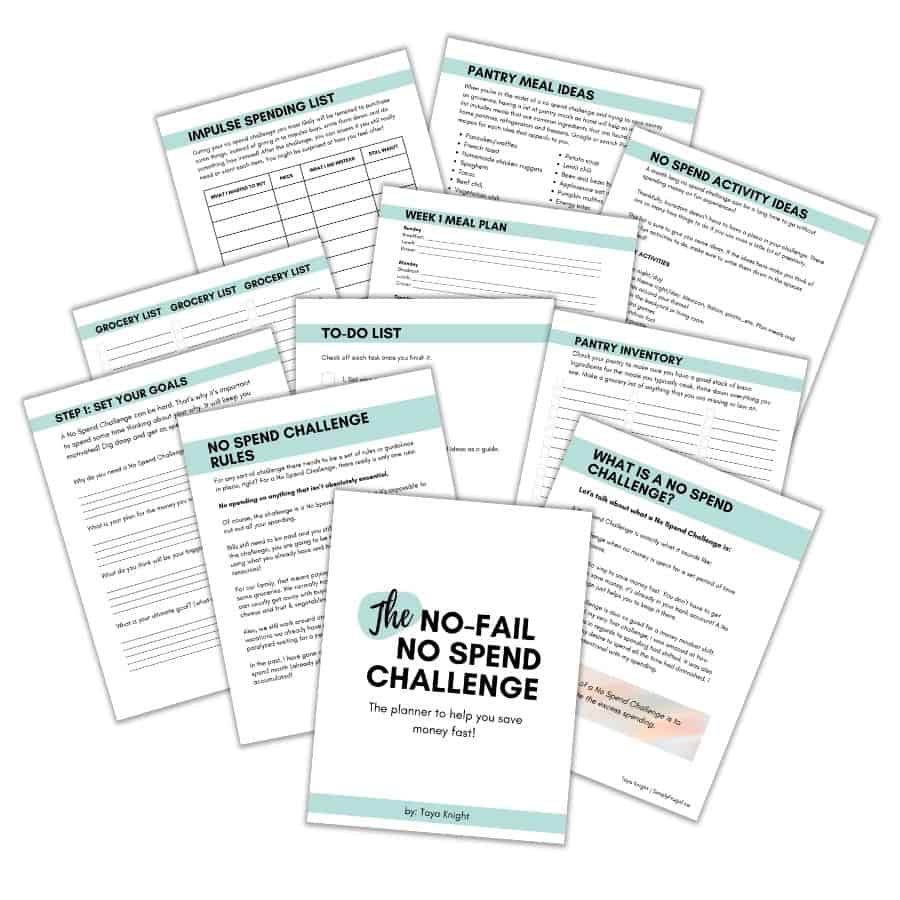
If you're really looking for an in-depth system for a successful no spend challenge, I recommend my No Spend Challenge Planner! It's 45 pages of instructions, no spend activity ideas, pantry meal ideas, before and after challenge questions, food inventory sheets, gratitude sheets and so much more! Take a look here!
Step 1: Determine the length
The first step is to determine the length that your no spend challenge will last. If this is your first no spend challenge, I suggest starting small. Maybe a weekend, a work week or 7 days. Starting small will pretty much ensure a successful no spend challenge.
As you start to see the fruits of your no spend challenge, you can increase the frequency of your weekend/work week/7 day challenges. Or you can jump into a 30 day challenge to see the greatest increase in your savings account.
Step 2: Look ahead to what's coming
Grab your calendar and take note of any events, birthdays or vacations you have coming up. You can either pick a period of time that avoids those events, or work around them.
I personally like to work around any events, birthdays, anniversaries, or family vacations we already have planned. This is so we don't become paralyzed waiting for a perfect month. After all, any month or day is a great day to save money!
I should note that it's possible to use creativity with planned events. In the past, I have gone on a quick vacation to Vancouver during a no spend month (already planned) and used only gift cards that I had accumulated!
Step 3: Take Inventory
This is a crucial step to having a successful no spend challenge.
Before I embark on a no spend challenge, I take inventory of my fridge, pantry, freezer and anywhere I keep household supplies.
I mark down everything I find. I'm often surprised at what I do find. Lol. Sometimes I have no idea that there are two pork tenderloins frozen in the freezer, for example.
During a typical month, food can be a huge area of the budget. By taking inventory for a no spend challenge, you will greatly reduce the amount of money you need to spend on food because you can use what you already have on hand.
This is a great time to quickly jot down some meals that you can make with the ingredients that you find.
Step 4: Use creativity
One of the hardest parts of a no spend challenge can be figuring out how to use what you have or learning to go without. This is where a bit of creativity can really pay off!
Here are some ideas to get your creativity flowing:
Trade your abundance with friends (have a lot of zucchini but need toiletries?).
Take to Pinterest to be inspired with meal ideas or simple DIY projects to create things with stuff you already have.
Save money by buying just one of something instead of 10.
Shop only where you have gift cards.
Order any groceries you need online so you aren't tempted to impulse buy.
Borrow a book, audiobook or video from your library.
Take advantage of free community events.
Carpool to work.
Declutter and sell items to make some cash.
Go on a walk with a friends instead of going for coffee.
A no spend challenge can be a real eye opener on how you really spend your money on a normal basis.
During a challenge, this is a great time to assess where you really value spending money. On the other hand, you can also assess what you are wasting money on without even realizing it.
Instead of spending money all the time as a solution, a no spend challenge will help you to work with what you already have. So needs may become wants as you work through creative solutions.
I have no doubt that a successful no spend challenge will teach you lessons that will last a lifetime.
How to do life after your challenge
Immediately after a successful no spend challenge is an important period.
You don’t want to fall back into any bad spending habitsor go on a shopping spree to make up for days without spending anything.
This is a good time to look at how much money you saved during your no spend period as well.
What do you plan to do with your savings? Are you going to transfer it to your savings account or use the extra money to pay some bills or debt?
After you decide what you’re going to do, take action immediately. Put the money to use right away, or you might be tempted to use it for the wrong thing.
One last thing. Remind yourself constantly of what you really want your money to do for you. Do you want to pay off your mortgage as quickly as possible? Do you want to spend a month traveling Europe? What ever your true financial goals are, write them down and keep them in a visible spot so you're constantly reminded. Don't shortchange yourself. You are worth it.
Whether it's a rainy day or a blistering hot day and you can’t go outside for fun with the kids, consider playing some fun indoor activities to stay entertained and occupied.
If you’re just not sure what to do, the following 50 ideas are fantastic, fun indoor activities worth considering:
You can’t go wrong with a good game of hide and seek. Find the perfect places to hide, such as in the basement, under the kitchen table, or even behind the couch.
2. Indoor Scavenger Hunt
Create an indoor scavenger hunt. Place items in different spots and see who can come across each of the hidden items first.
3. Tic-Tac-Toe
Grab a sheet of paper, a pen, and some markers and start playing a good old-fashioned game of Tic-Tac-Toe. It’s fun, easy to do without any equipment, and perfect for kids of all ages.
4. Charades
Have fun showing activities without saying what they are while everyone else tries to guess. A good game of charades lasts for hours and leaves the whole room smiling from ear to ear.
5. Simon Says
Why not play a good ol’ game of Simon Says. Let each person in the household take turns being Simon to make things more exciting for everyone.
6. Duck, Duck, Goose
Bring out your inner child with a traditional game of Duck, Duck, Goose. It’s easy for even young children to understand the rules.
7. Connect Four
Connect Four is a great game to play one on one. if you don’t have the gameboard, you can still play a good game of Connect Four with the family. See who can connect four colored dots in a row first.
8. Jenga
Bring out the box of Jenga and start stacking those bricks. It’s a fun and simple game that can keep families occupied for hours.
9. Homemade Obstacle Course
Set up a homemade obstacle course in the house. This is one of our favorite things to do! Of course, make sure it’s a safe one so that the kids can test their skills while having a good time.
10. Dots and Boxes
Play a game of dots and boxes. All you need to play this game is a sheet of paper, some pencils, and markers. It’s that simple.
11. Balloon Toss
Enjoy a game of balloon toss. Blow up a balloon or several balloons and toss them up, but don't let them hit the floor!
12. Musical Chairs
Do you remember when you were in school and you’d play musical chairs? Now you can do the same thing at home with your kiddos.
13. Twister
Who doesn’t enjoy a good game of Twister? My girls share so many laughs with a game of Twister! If you have it at home, place it on the floor of your living room or dining room and have a fun time with the family.
14. Chess
Play a strategy game with loved ones by partaking in the game of Chess. If you have multiple boards, you can have different people in the household playing together.
15. Checkers
Similar to chess but even easier, checkers is another fun game to play inside on rainy days when you want to keep your children entertained.
16. Pin the Tail on the Donkey
Who says pin the tail on the donkey is only for birthday parties? You can set one up in the house, blindfold everyone, and see who makes it closest to the tail.
17. Laser Tag
If you have kid-friendly laser guns at home, turn off the lights, close the blinds, and enjoy a good game of laser tag.
18. Nerf Gun Battle
Load the nerf guns with bullets and get into the battle of a lifetime. It’s a fun way to spend an hour or more running around with the kids.
19. Mini Basketball
Grab a mini basketball and mini hoop and play in an area in the house, such as the playroom or the garage.
20. Indoor Bowling
Get ready for some indoor bowling. You can use plastic bottles as the bowling pins and use a pair of rolled up socks at the bowling ball.
21. Ring Toss
Keep busy with a good game of ring toss. See who can get the most rings on the bottles to win a small prize.
22. Candyland
Candyland is a top-rated board game for a reason. Children love it! So, if you have it at home, pull it out and get ready to have some fun.
23. Mini Air Hockey Table
Play some air hockey with the kids on a mini air hockey table. Things can get competitive rather quickly!
24. Darts
Enjoy a competition that involves throwing darts on a dartboard to see who can hit the target the most. It’s entertaining!
25. Bean Bag Toss
If you have some mini bean bags at home, set up target areas with tape on the floor and aim your bags to those areas. See how many points each person can get.
26. Hopscotch with Tape
Create a hopscotch using tape instead of chalk. It’s a fun way to keep the kids active, even on a rainy, boring day.
27. Hamper Toss
Put a hamper or laundry basket on one side of the room and see how many shots each person can make using a small ball or rolled up pair of socks.
28. Monopoly
Another great game to play on a rainy day, Monopoly never gets old. You might even have a few different versions of the game that you’d like to play with the family.
29. Clue
Bring the suspense and mystery to your home with Clue. This was one of my favorite games when I was a kid. I remember playing with my cousins!
30. Ping Pong
Enjoy a ping pong battle that tests your speed and endurance. You’ll have the kids tired in no time when they’re playing this game.
31. I Spy
Keep it simple with a quick game of I Spy. See what things you notice and vice versa inside the home.
32. Tag
If you don’t mind running around in the home, tag is a great option. Be sure to let the kid take turns when it comes to who is it and who isn’t.
33. Block Building Competition
Have a block building competition with your loved ones. Find out who can get as creative as possible using the blocks to build something unique.
34. Plastic Horseshoes
Play with plastic horseshoes inside the home. It’s as fun as the original game and safer for children because the horseshoes aren’t so heavy.
35. Red Light, Green Light
Get the kids moving around and laughing with a good game of Red Light, Green Light. Children love this game!
36. Tea Party
Okay, it’s not as much of a game as it is a relaxing thing to do, but having a tea party is a great way to spend a rainy day. It’s fun and can keep your little ones entertained even longer.
37. Cops and Robbers
Did you play cops and robbers as a kid? If so, show your children what it was like. They’ll probably love the game as much as you did.
38. Wrestling Competition
Consider having a wrestling competition if your children love to wrestle. Be sure to set the rules in advance.
39. Ninja Skills
Play games that enhance ninja skills, such as indoor climbing and swinging. With this indoor ninja warrior course, this is sure to become one of the best fun indoor activities.
40. Stuffed Animal Hide & Seek
We have spent many hours hiding stuffed animals around the house for the kids to find! They think it's the best game every time.
41. Animal Hopping Game
Have your children hop like animals from one side of the room to the next. It’s a great way to get them moving around and having a good time while sharing lots of laughs.
42. Balloon Volleyball
Play volleyball with a balloon, bouncing it from one side to the next. It’s a lot safer to use a balloon when playing volleyball in the house.
43. Indoor Hockey
Use a plastic puck and sticks to play a game of indoor hockey. Instead of skates, you’ll wear socks to glide around the room.
44. Balloon Hockey
Yep, you can even play hockey with a balloon. It’s going to be more of a challenge, but that makes it fun and exciting, too.
45. Floor Is Lava
Kids love playing Floor Is Lava. Make it fun by putting different obstacles around on the floor for them to jump from one spot to the next. This is for sure one of the most memorable, fun indoor activities!
46. Letter Learning Game
Place letters on the floor and have your children jump or do different movements to get to each one. This game is fun for younger children learning to recognize letters.
47. Go Fish
Bring out the cards and play a game of Go Fish. It’s been around for decades for a reason!
48. Speed Card Game
Teach your children how to play Speed, a classic card game. It can keep them entertained for hours.
49. Sensory Bucket Game
Fill a bucket with sand and toys and then have your children dig through the bucket to see what they can find. The sensory bucket is fun and improves fine motor skills.
50. Sock Toss
Don’t forget about the sock toss! Roll your socks up and aim them at a basket or specific spot on the floor.
With fun indoor activities like these, you don’t have to worry about feeling bored on a rainy or blistering hot day with the family!
What is one of your family's favourite fun indoor activities to do?
Next time you're invited to a baby shower, this list of inexpensive but unique baby gifts may just be what you need to get inspired.
The ideas are fun, practical and most importantly, fit into nearly any budget.
With the low-cost ideas listed here, you can gift a unique baby gift to your friends or family members to help welcome their new addition that they will appreciate.
A diaper cake.
A diaper cake is a great way to gift useful items and stay in budget. Even a small box or bag of diapers can be rolled and tied together using inexpensive ribbon to create a cute gift.
Following along with another more practical gift idea, a stroller fan might be a wonderful gift idea for the parent that likes to be out and about.
As a practical person at heart, useful but unique baby gifts would have made me the happiest. Lol.
A coupon to come do chores for the new parents.
A new mom and dad are definitely going to need a bit of help in the early days. This could include an offer to clean their home before or after the baby arrives. It may be offering up some freezer meals, or even babysitting older children so they can sleep.
Find out what needs they have and offer a coupon to the new parents to use when they need it most.
Gift cards for restaurants that deliver to their home.
This may not seem like one of the most unique baby gifts, but it is a great choice that will be appreciated.
Sometimes the very idea of cooking at home is overwhelming, not to mention trying to load an infant into a car and drive to buy dinner.
Gift cards for take out that will deliver are an excellent way to help a new parent. A gift card for Skip the Dishes or Uber eats would also be excellent.
They are especially great for those moms who are facing a c-section at birth and may be stuck at home longer than most due to healing.
Alternatively, you could gift a pre-made meal. Perhaps a homemade soup mix or two full of beans, lentils and spices that the new parents can just add water to.
A sound machine.
This gift is invaluable in early days to help a baby fall asleep easier. While more expensive than others on this list, I highly recommend a white noise machine as one of the best unique baby gifts.
While there are many options out there,I love the Dreamegg white noise machine. One of the ones that we had has a dim light, so it was perfect for middle of the night visits. They are also small enough to be great for travelling.
Custom name sign.
If the baby has already arrived and you know the name of the baby, a custom name sign would be a wonderful gift idea.
Etsy has so many different handmade options. You could choose something with just the name, or something with the name and birth statistics. The options are endless really.
Try to match the nursery colors, if you know what they are, for a great option to gift to the new parents.
A Cuddle + Kind Handmade Doll
My daughters each have a Cuddle+Kind doll and they are truly beautiful and unique. I especially love that with the purchase of 1 doll, 10 meals are provided to children in need around the world.
A hooded towel
My daughters are still using the ones they were gifted when they were babies! They think the animal on the hood is just the most fun.
This Michley brand has many different animal options that I think would be fun paired with a corresponding book.
Bath toys
Bath toys are perfect to have on hand for when the little one gets older.
My daughters always liked the foam letters, little animals that squirt water, and stack and pour cups.
Their all time favourite though was this Yookidoo bath toy. They used it for the longest time!
A diaper bag backpack
A diaper bag backpack is the perfect gift for any mom, but especially those with multiple kids! They are so much better than a traditional diaper bag because you can carry it and be hands-free to wrangle the kids.
They are much more comfortable to lug around and are so practical with all the pockets they have.
A few books
You can never go wrong with gifting books! The new parents will be doing plenty of reading over the years that new books will be so appreciated!
These are some great inexpensive but unique baby gift ideas that are easy to fit into any budget. Gender neutral and easy to accomplish, these ideas are sure to make it easy for you to give a gift for any new baby announcement you receive.
What are you favourite unique baby gifts to give for new babies?
Menu planning and I have had some ups and downs over the years, due to various life seasons, but I always come back to menu planning because it has SO MANY benefits.
I started menu planning when my husband and I got married way back in the fall of 2007. I was hoping it would make life simpler.
Nearly 15 years later, with mostly consistent planning, I'm finding that it does and I absolutely love it!
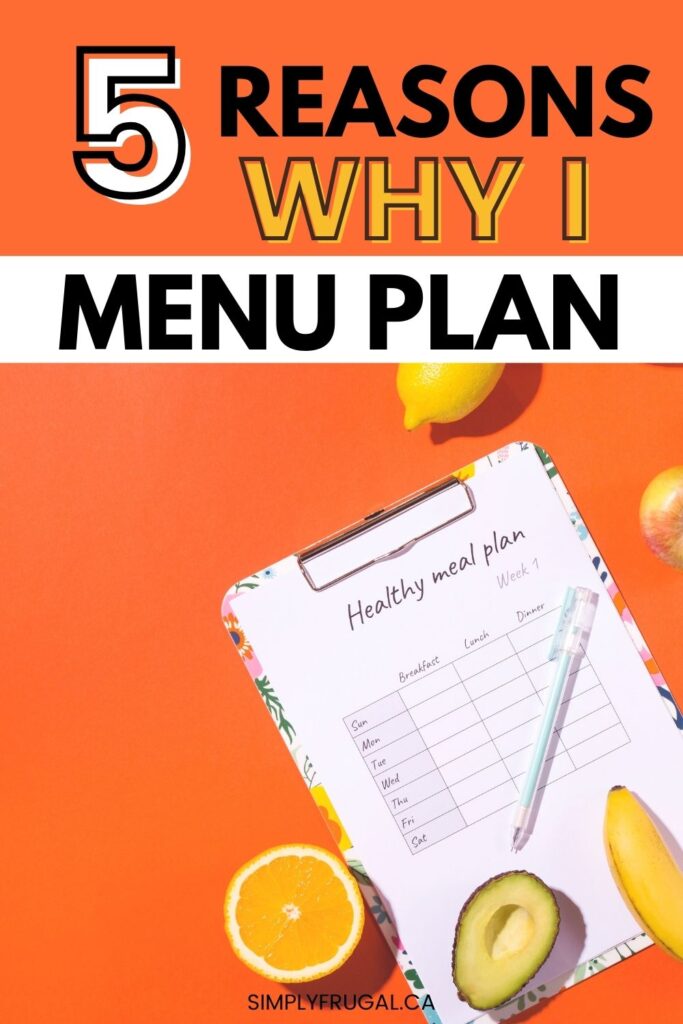
If menu planning seems like another chore that you don't want, today, I'd love to tell you the 5 things that I love about menu planning!
I only shop once a week.
When I was living on my own, if I wanted to make something specific, I would go to the store that day to purchase any ingredients I needed.
If you're anything like me, a trip to the grocery store for only a couple of things, turns into purchasing many unexpected things. Doing this a few times each week, I was obviously spending more than I needed to by going more than once a week.
With a menu plan in place, I can limit my grocery shopping to once a week because I've accounted for all the ingredients and staples I need based on what I already have and what's on sale.
Less temptation to eat out.
In other words, we save money AND eat healthier by having a menu plan. But because we enjoy eating out once a week or so, I actually factor our meal out into my menu planning so I don't buy any wasted ingredients.
I have more motivation.
Cooking isn't my favourite thing to do these days. However, when I have a plan in place, I've eliminated a big part of the battle.
I don't struggle for meal ideas or have any missing ingredients. I can just jump right into meal creation almost thoughtlessly. I almost get excited about making dinner, because I already know what I will be making!
Before I menu plan, I take a quick look through the pantry, fridge and freezer to see which ingredients I have on hand. I can usually think of one or two simple meals using what I already have.
My next step is take a look in my local grocery flyers to see what is on sale. I plan some more meals based on what's on sale.
With both of those strategies in play, I am less tempted to impulse buy because I know I won't need that item.
I also like to make plenty of dinner so that there is enough leftover for lunches the next day. This helps eliminate the need to eat out for lunch!
It's a good use of my time.
It takes me less time to plan a weekly menu plan then it does to think up a meal each and every day at meal time. I'm a big fan of using my time efficiently. 😉
There you have it, 5 reasons why I love menu planning! Do you menu plan? If so, why do YOU menu plan?
I've had quite a few people mention that they struggle with knowing how too afford healthful, whole foods. I'm here to give you some useful tips today that should have you knowing how to save money on whole foods in no time!
When you're looking to feed your family a healthy diet, the cost of fresh, whole foods can be a bit scary and perhaps a big turn off. Despite what some people tell you, real food is NOT cheaper than junk food. That puts a huge strain on families trying to survive on a budget.
Here are some tips you can put to use right away to help you save money on whole foods:
Visit the Farmer's Market.
Take a visit to your local farmer's market for amazing produce deals. Visiting closer to closing time will get you extra discounts as vendors work to clear out stock so they don't have to pack it up. The local Farmers Market will be packed with locally grown, in season produce.
Start a garden.
Even if you live in the city you can grow some vegetables in pots! If you're lucky you can grow an entire garden to cut the costs of feeding your family whole foods.
Eat foods that are in season to save money all the while eating whole foods on a budget. Foods that are in season tend to be a great deal cheaper. Preserve foods as they are in season so you can enjoy them all year round.
Look for a CSA (Community Supported Agriculture) or co-op in your local area for great deals on produce, eggs, and even pasture fed meats. A quick google search or asking around with friends should reveal a few options. Most require you to sign up in the winter for the following season.
U-Pick
Do a google search for u-pick farms near you. By picking produce yourself you get a workout, quality family time, and a steep discount on amazing produce to feed your family. Bring the whole family and pick enough to store away for the rest of the year.
Shop in bulk.
Shop the bulk bins at the grocery store for things like grains, nuts, and seeds at a discount compared to buying prepackaged goods. These bins often have sales as well so you can stock up a bit more if the budget allows. In this case, air-tight containers are your friend for storage.
Manager Specials.
Keep an eye out for manager specials on produce, meats, and dairy. These usually need to be frozen or used right away but with the price, but it's worth the work. When putting your groceries away place all of your clearance finds in one spot and deal with them that night so you won't forget about them.
Learn the art of food preservation.
You can take advantage of deals on whole foods by learning how to store them long term. You have several options and doing a combination of them will yield the best results. Great options include freezing, canning, and dehydrating fresh foods for later use.
By implementing these tips, you should start seeing significant savings when you're eating whole foods. I'd love to know your tips on how to save money on whole foods in the comments below!